
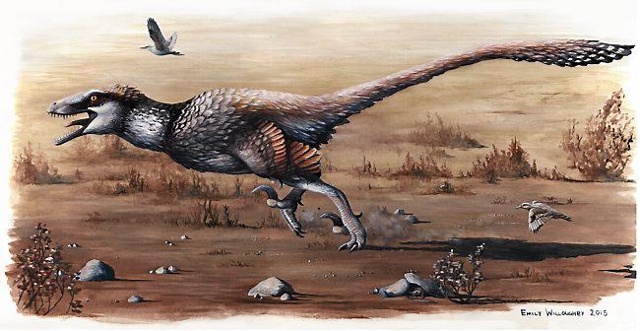
Artists rendition of the Dakotaraptor
The raptor, named Dakotaraptor, lived a few 66 million years ago and was about 17 feet long with claws almost 10 inches, making it the largest dinosaur ever found with wing feathers.
Upon analysing the fossil, the research team found ulnar papilli or what is termed as quill knobs on the ulna of the giant raptor.
This particular raptor would have been very large, measuring in at about 16 or so feet in length - much larger than many raptors, but of course much smaller than most predators roaming the earth at that time. The peer-reviewed paper was published in the journal Paleontological Contributions on October 30.
Fossilized winged giant raptor found in South Dakota represents a major discovery bridging an evolutionary gap of the Cretaceous Laramidia Landscape. It's unlikely Dakotaraptor could fly given its large size, but perhaps it used its feathers for display or to keep its eggs warm, D-Brief reported.
"This new predatory dinosaur also fills the body size gap between smaller theropods and large tyrannosaurs that lived at this time", David Burnham, a paleontologist at Kansas and co-author of the new study, said in a press release.
Dakotaraptor may have been massive for a raptor, but its size lies right between those of two groups of dinosaurs.
Robert said "This Cretaceous period raptor would have been lightly built and probably just as agile as the vicious smaller theropods, such as the Velociraptor". Robert De Palma, curator of vertebrate paleontology at the Palm Beach Museum of Natural History and lead author of the study explained. Quill knobs are a stand out clue to the existence of feather quills on the forearm of the Cretaceous Dakotaraptor.
While the Dakotaraptor was too large for flight, the presence of quill knobs suggests the animals were evolving closer to modern birds. Dakotaraptor likely used its wing feathers as a way to attract mates, shield young offspring from predators or to pin down prey when hunting. The formation stretches across four states, Montana, North Dakota, South Dakota, and Wyoming.
This new discovery could change researchers' perspective of the region's prehistory.
More news: Red Sox's Clay Buchholz: Club option exercised by Red Sox
