
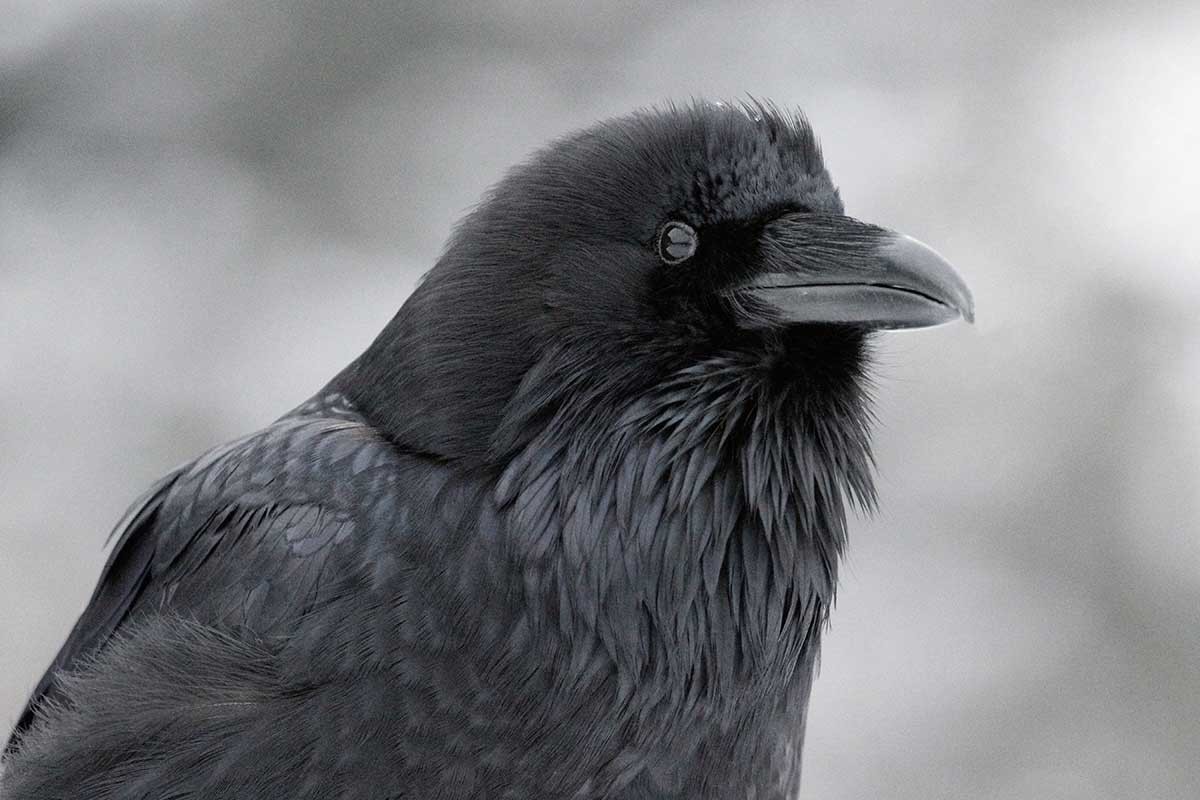
I know what you are thinking John E Marriott Getty
Those previous studies have also suggested that animals can understand what others see but in their case the test subjects had the possibility to see each another's eyes or head.
It materialized that ravens, believed to be one of the most intelligent birds as it is, pay particular attention to the hiding process if there's any suspicion that another bird might be present.
In other words, the birds met the researchers' criteria for Theory of Mind by incorporating information from their own experiences with novel ones, to predict how others might act and how to adapt their own behavior appropriately. A group of scientists published their findings in the journal Nature Communications, revealing how impressive ravens' cognitive abilities are. Be especially careful to hide their food if they suspect are observed by another Raven, even if they do not see the other birds their movements.
In mythology from around the world, ravens are seen as clever birds that will easily find you out if you cross them. Ravens, however, have shown that they are capable of building mental abstractions without what scientists call "gaze cues".
Cameron Buckner, assistant professor of philosophy at the University of Houston said that the finding has shed fresh light in science's understanding of Theory of Mind, the capability to attribute mental states, like vision to others. Buckner explained that in their experiment the researchers avoided that concern by using sound and open peepholes to indicate the presence of a possible competitor.
Martin Schmelz at the Max Planck Institute for Evolutionary Anthropology in Leipzig, Germany, says the study refutes a major argument against previous studies and shows exciting social cognitive abilities in ravens for the first time.
The researchers that that it is the human ability to see things through another person's eyes, and to think about what they might be thinking, skills that is referred to as "Theory of Mind".
To test it out, they separated two experiment areas with a wall, which they fitted with a window and a small peephole, visible when the window was shut. The ravens were trained to look through the peepholes to observe human experimenters making stashes of food.
In a groundbreaking study, the close relatives to crows were taught that they could be spied on through a peep hole as they hid food. The birds who thought they were being watched would hurry to hide their goodies and only return to them later when the coast was clear, Discovery News reports.
"This strongly suggests that ravens make generalizations based on their experience and do not merely interpret and respond to behavioral cues from other birds", Bugnyar told the Guardian. At the same time, they turned on a hidden speaker that played sounds of a raven competitor, although no other raven was actually present. "Consequently, we argue that they represent "seeing" in a way that can not be reduced to the tracking of gaze cues".
Even without those cues, the ravens showed an understanding that they might be being watched, and changed their behaviour accordingly.
He added: "It could change our perception of human uniqueness, that we share some of that ability not just with chimpanzees and closely related species but also with a very different species". Some say Theory of Mind helped develop language: you point and say chien, I say dog, but we can both figure out what we mean.
More news: School spirit: St. Gerald celebrates faith, fun during Catholic Schools Week
