
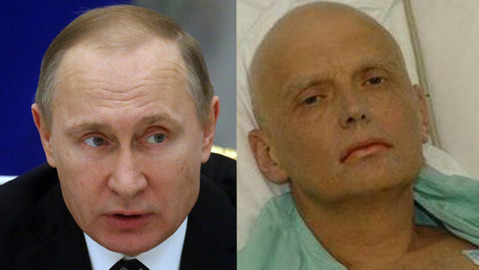
A UK judge believes Vladimir Putin'probably approved Alexander Litvinenko's killing
But when he took into account all the evidence available to him, including a "considerable quantity" of secret intelligence that was not aired in open court, he found "that the FSB operation to kill Litvinenko was probably approved by [Nikolai] Patrushev [head of the Russian security service] and also by President Putin".
Litvinenko, 43, an outspoken critic of Putin who fled Russian Federation, died after drinking green tea laced with rare radioactive polonium-210 at London's Millennium Hotel in 2006.
Judge Robert Owen, the inquiry's chairman, said he was "sure" that Lugovoi and Kovtun placed polonium-210 in a teapot at the Millennium Hotel's Pine Bar, where they met Litvinenko on November 1, 2006.
The British government says it will freeze the assets of the two suspects.
Speaking before Parliament, U.K. Home secretary Theresa May called the poisoning "a blatant and unacceptable breach of the most fundamental tenets of global law and civilized behavior", but conceded that Putin's apparent role "does not come as a surprise".
The report says that the Russian government considered Litvinenko to have "betrayed" it, both for his public remarks before he left Russia and, later, for allegedly working for British intelligence.
Alexander Litvinenko died in 2006.
British prime minister David Cameron has condemned Russian Federation over the inquiry's findings, widening a rift with Moscow.
The report's author Sir Robert Owen singled out then-FSB chief Nikolai Patrushev alongside the Russian president.
Moscow has always strongly denied involvement in Litvinenko's death, and Russian Federation refuses to extradite the two main suspects, Andrei Lugovoi and Dmitry Kovtun.
While living in his native Russia, Litvinenko worked for the FSB, specializing in organized crime.
Responding to the report today, Russian Foreign Ministry spokesperson Maria Zakharova said, "We regret that the purely criminal case has been politicized and has marred the entire atmosphere of bilateral relations".
"When Mr Lugovoi poisoned Mr Litvinenko it is probable that he did so under the direction of the FSB", Owen concluded.
It has been described as a "mini nuclear attack" on the streets of London.
Russian Federation dismissed the findings, calling the inquiry "politically motivated".
Responding to the report, Mr Lugovoi, who is now a politician in Russia, said the accusations against him were "absurd", the Russian news agency Interfax was quoted as saying.
Marina Litvinenko, widow of former Russian spy Alexander Litvinenko, places her arm around her son Anatoly during a press conference in London, Thursday, Jan. 21, 2016.
"This can be seen as the product of the elegant sense of humour of the British, when a public and closed investigation rests on undisclosed information from unnamed intelligence services and the ample use of the words "possibly" and "probably", he said.
More news: Broncos to face Panthers in Superbowl 50
